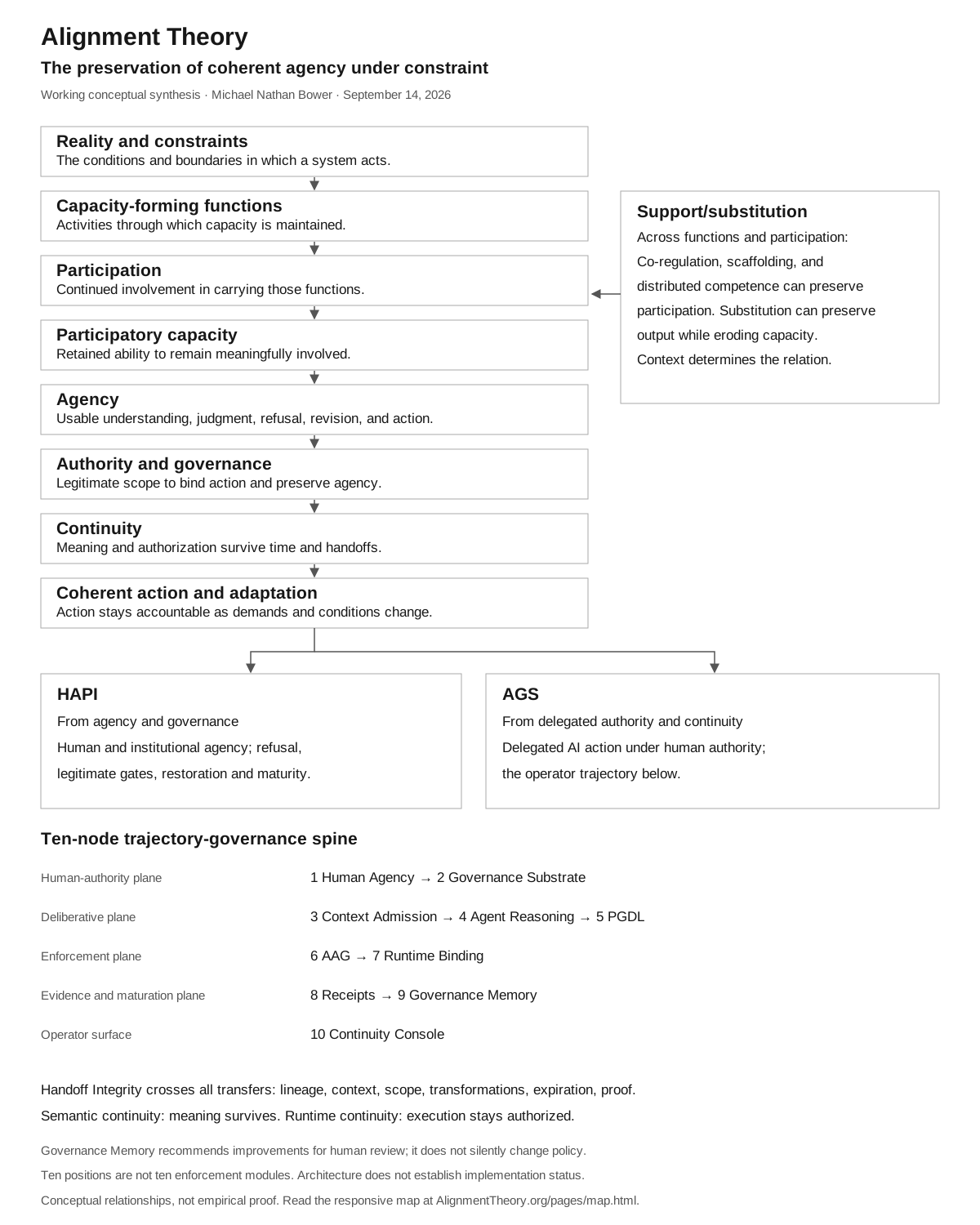
Framework

Alignment Theory is a structural framework for understanding how humans become coherent, fragmented, governed, counterfeited, and restored. It distinguishes internal alignment from external alignment, explains how truth, agency, and meaning relate to coherence, and shows how false systems convert inward reality into externally legible substitutes. At its deepest level, the framework argues that truth is intrinsically integrative because reality is ordered through Logos, that evil is distortion of good structure, that salvation is realignment with reality itself, and that Christ is the central revelation of restored truth, freedom, and being.

This page is the compressed center of the framework: use it for the governing distinctions, the threshold model, and the main paths into the deeper reference pages.

Backbone statements

Compressed Center
  1. Low agency increases steerability.
  2. Visible order can exist without inner coherence.
  3. Truth is intrinsically integrative.
  4. Evil is distortion of good structure.
  5. Salvation is realignment with reality itself.
  6. False religion secures belonging through sacred external order instead of inward transformation.
  7. False systems replace inward reality with externally legible substitutes.
  8. Meaning is discovered more than invented.
  9. The narrow path is narrow because deep alignment costs more than adaptation to constructed reality.
  10. Christ is the living center where truth, freedom, and restored reality converge.

Fear, Self, and Moral Integration

Framework Synthesis

How scripture, contemplative neuroscience, and psychedelic research converge on a common human pattern.

Across scripture, contemplative neuroscience, and psychedelic research, a recurring pattern appears: when fear-driven self-protection loosens, unity becomes more available. Scripture frames this as inner transformation, love overcoming fear, and the law written on the heart. Neuroscience frames it as changes in self-referential processing, attention, and emotional regulation. Psychedelic research frames it as acute disruption of rigid self-modeling, altered threat processing, and increased connectedness or empathy. The overlap is not proof that all three domains are identical. It is a convergence around a common human pattern.

Scripture

Inner Law

Scripture repeatedly shifts the center of moral life inward. Fear, hypocrisy, and outward conformity are treated as signs of disordered life, while love, inner renewal, and fruit are treated as signs of genuine transformation.[1][2][3][4][5][6] The movement is from externally imposed law toward inwardly organized moral life.

Neuroscience

Self-Processing

Contemplative neuroscience suggests that some meditative practices are associated with reduced default-mode activity, less mind-wandering-like processing, and changes in networks involved in attention and self-monitoring.[7][8] Other work on prayer and spiritual practice shows measurable neural effects as well, but not one universal pattern.[9][10] The point is not that all practices are neurally identical, but that shifts in self-referential processing and attentional regulation appear to matter.

Psychedelics

Unstable Opening

Psychedelic research suggests that classic psychedelics can acutely loosen rigid self-modeling and alter emotional processing, sometimes producing experiences of unity, connectedness, or self-transcendence.[11] Some controlled work also suggests increased emotional empathy. But these findings should not be inflated into a claim that psychedelics automatically produce mature moral reasoning or lasting wisdom: in one controlled psilocybin study, emotional empathy increased while moral decision-making did not significantly change.[11]

Convergence

The shared pattern is that fear tends to narrow the self, while love, trust, and reduced defensive rigidity widen it. When the system is less dominated by threat and self-protection, empathy, connectedness, and inwardly organized moral life become more available. Scripture describes this spiritually, neuroscience describes it functionally, and psychedelic research describes one powerful but unstable route into similar experiential territory.

Important Limit

Neuroscience does not prove theology. Psychedelics do not equal repentance, sanctification, or durable alignment. Emotional empathy is not identical to moral wisdom. The strongest claim is narrower: these domains converge on the idea that loosening fear-driven self-protection can open the door to greater unity, empathy, and inward transformation.

State Access Is Not Moral Formation

Companion Distinction

Why a temporary opening is not the same as inward transformation.

Psychedelics and other substances may sometimes open a temporary state of unity, reduced fear, softened self-boundaries, or increased connectedness. But an opened state is not the same thing as a formed person. Biblical transformation is not defined by access to an experience. It is defined by renewal, sobriety, self-control, and the gradual formation of durable moral fruit.[12][13][14]

Main Distinction

A substance may interrupt rigid self-protection for a moment. It does not automatically build the structure needed to carry truth, love, discipline, or moral clarity over time. This is the central distinction: externally induced access is not the same as internally developed alignment.

Scriptural Framing

Scripture consistently points toward sober-mindedness, renewal of the mind, self-control, and fruit-bearing transformation.[12][13][14] The emphasis is not merely on touching an intense state, but on becoming the kind of person whose life is inwardly reordered. The biblical movement is from outward pressure to inward law, from impulsive or unstable states to durable character.

Important Limit

This does not mean every altered-state report is false or meaningless. It means the mechanism of entry matters. A temporary opening may resemble aspects of unity, but resemblance is not equivalence. A chemically induced state is not identical to repentance, sanctification, or stable moral formation.[15]

Tight Synthesis

Psychedelics may open a state. They do not build a person.

A substance can open the door, but it cannot become the soul.

An externally induced opening is not the same thing as internally formed alignment.

One-line version

Unity is what experience feels like when fear loosens its grip on the self and moral order begins moving from outside enforcement to inside integration.

References

  1. 1 John 4:18.
  2. Jeremiah 31:33.
  3. Romans 12:2.
  4. Galatians 5:22–23.
  5. Mark 7:6–8.
  6. Isaiah 29:13.
  7. Brewer JA et al. Meditation experience is associated with differences in default mode network activity and connectivity. PNAS. 2011.
  8. Garrison KA et al. Meditation leads to reduced default mode network activity beyond an active task. Cogn Affect Behav Neurosci. 2015.
  9. Newberg AB et al. Cerebral blood flow during meditative prayer: preliminary findings and methodological issues. 2003.
  10. Newberg AB. The neuroscientific study of spiritual practices. Front Psychol. 2014.
  11. Pokorny T et al. Effect of Psilocybin on Empathy and Moral Decision-Making. Int J Neuropsychopharmacol. 2017.
  12. 1 Peter 5:8.
  13. Romans 12:2.
  14. Galatians 5:22–23.
  15. Pokorny T et al. Effect of Psilocybin on Empathy and Moral Decision-Making. Int J Neuropsychopharmacol. 2017. In a controlled psilocybin study, emotional empathy increased, but moral decision-making did not significantly change.

The Civilizational Threshold Ladder

Core Framework

A Map of Armageddon Patterns

This ladder describes the recurring pattern by which civilizations lose coherence. Hidden disorder accumulates before visible collapse. More often, internal coherence weakens first, external control rises to compensate, fragmentation becomes visible, and threshold pressure marks the point where instability is becoming openly consequential. Visible rupture is not the beginning, but the disclosure.

Collapse is usually preceded by latent instability, long-ripening disorder, and rising maintenance cost.

  1. Coherence

    • shared meaning still works
    • institutions still carry trust
    • people can regulate themselves without heavy pressure
    • truth can still be integrated at human speed
  2. Overload

    • complexity rises faster than people can metabolize it
    • urgency compresses thought
    • fear starts narrowing perception
    • hidden disorder accumulates before it becomes politically obvious
    • people begin trading nuance for certainty
  3. Compensation

    • authority starts replacing understanding
    • identity hardens
    • rules start doing the work conscience can no longer carry
    • people seek stabilization more than truth
  4. Compression

    • dogma forms
    • uncertainty becomes threatening
    • systems punish doubt
    • performative certainty spreads
  5. Externalization

    • surveillance grows
    • bureaucracy grows
    • enforcement grows
    • long-ripening disorder starts moving into public consequence
    • outward compliance replaces inward transformation
  6. Fragmentation

    • trust falls
    • polarization rises
    • shared language weakens
    • factions become easier than integration
  7. Threshold Crossing

    Threshold Pressure

    • the system still functions, but at rising cost
    • every shock hits harder than it should
    • enforcement becomes expensive
    • latent instability is becoming openly consequential
    • order looks maintained, but only artificially
  8. Outcome

    Disclosure
    Collapse
    • schism
    • scattering
    • institutional failure
    • the visible rupture discloses prior internal decay
    • coercion, rupture, or breakdown
    Repentance / Reordering
    • simplification
    • restored agency
    • reduced load
    • judgment is met as disclosure rather than denied as surprise
    • truth slowed back into the integration corridor

One-line version

Coherence → overload → compensation → compression → externalization → fragmentation → threshold pressure → collapse or repentance

Bible-shaped version[1]

Order
→ hidden hardening
→ outward religion / inward decay
→ warnings and woes
→ judgment through consequences
→ either scattering or renewal

Tight framing for the theory

Civilizations do not usually fail all at once. Hidden disorder accumulates before visible collapse, and the visible rupture is not the beginning, but the disclosure.

Judgment is the externalization of long-ripening disorder. Armageddon-patterns describe not a date chart but a convergent condition in which accumulated misalignment becomes openly historical.

References

  1. The “Bible-shaped version” is an interpretive shorthand drawing especially on Matthew 23, Isaiah 29:13, Mark 7:6–8, Jeremiah 31:31–34, Hebrews 8:10, and Ezekiel 36:26–27.

Core Axioms

Foundations

Starting assumptions about structure, truth, agency, distortion, meaning, salvation, and Christ.

Open core axioms

Core Laws

Dynamics

Law-like statements describing how regulation, control, legibility, meaning, and simulation behave over time.

Open core laws

Biblical Grammar of Alignment Theory

Scriptural Grammar

Repeated orienting translations for reading biblical language through the framework's structural distinctions.

Open biblical grammar

Scripture Explorer

Study Reference

A practical Bible-study and passage-reference tool for tracing the main texts, recurring patterns, and restrained cross-domain notes used across Alignment Theory.

Open scripture explorer

Scripture, Regulation, and Inner Transformation

Bridge Page

A disciplined cross-domain study page showing how scripture, Alignment Theory, and neuroscience describe overlapping patterns of inward regulation, renewal, threat, and behavioral formation.

Open regulation page

Research Backbone

Source Page

A disciplined source-and-citation page showing where the framework's human-regulation layer overlaps with existing scientific and organizational literatures.

Open research backbone

Alignment Theory Lexicon

Translation Layer

Stable native vocabulary paired with formal equivalents for readers crossing domains.

Open lexicon

One Pattern Across Scales

Scope Page

A proof-of-scope page showing how the same Alignment Theory pattern scales from nervous system regulation to institutions, civilization, and scripture.

Open scale page

One Pattern, Many Languages

Cross-Disciplinary

A careful bridge page showing how multiple disciplines describe overlapping structural patterns without collapsing their differences.

Open translation page

Metaphysical Claims

Deep Claims

The framework's largest claims about reality, Logos, evil, meaning, salvation, and Christ.

Open metaphysical claims

Essays

Expansion

Use the essays to expand, test, and interpret the compressed framework in long form.

Open essays

Library

Archive

Use the library as the formal archive for versioned artifacts, supporting pieces, and catalog metadata.

Open library