Research on coherent agency under constraint across human and artificial systems.
ACTIVE RESEARCH CORPUS — v1.1 | Updated April 27, 2026
AI Alignment Research
Author: Michael Nathan Bower
Canonical source: AlignmentTheory.org
Framework: Alignment Theory
Status: Original research framework and applied constraint model
First published: 2026-05-06
Last updated: 2026-05-06
Applied AI governance branch
This page is the main entry point for Alignment Theory's applied AI governance work.
Agent Action Gate as Reference Implementation
Agent Action Gate is a reference implementation of Alignment Theory's pre-execution oversight layer for agentic AI systems.
It operationalizes the Alignment Theory claim that systems become dangerous when cognition turns into action faster than human participation, review, or correction can occur.
A research program for behavioral drift detection, objective anchoring, runtime realignment, and production AI governance.
Alignment Theory treats AI alignment as an ongoing control-loop problem: define the objective, enforce constraints, monitor behavior, detect drift, route meaningful deviations to review, and re-anchor the system over time.
For the current theory, begin with Start Here, the Revised Framework Center, or the Current Framework Map.
Current Map
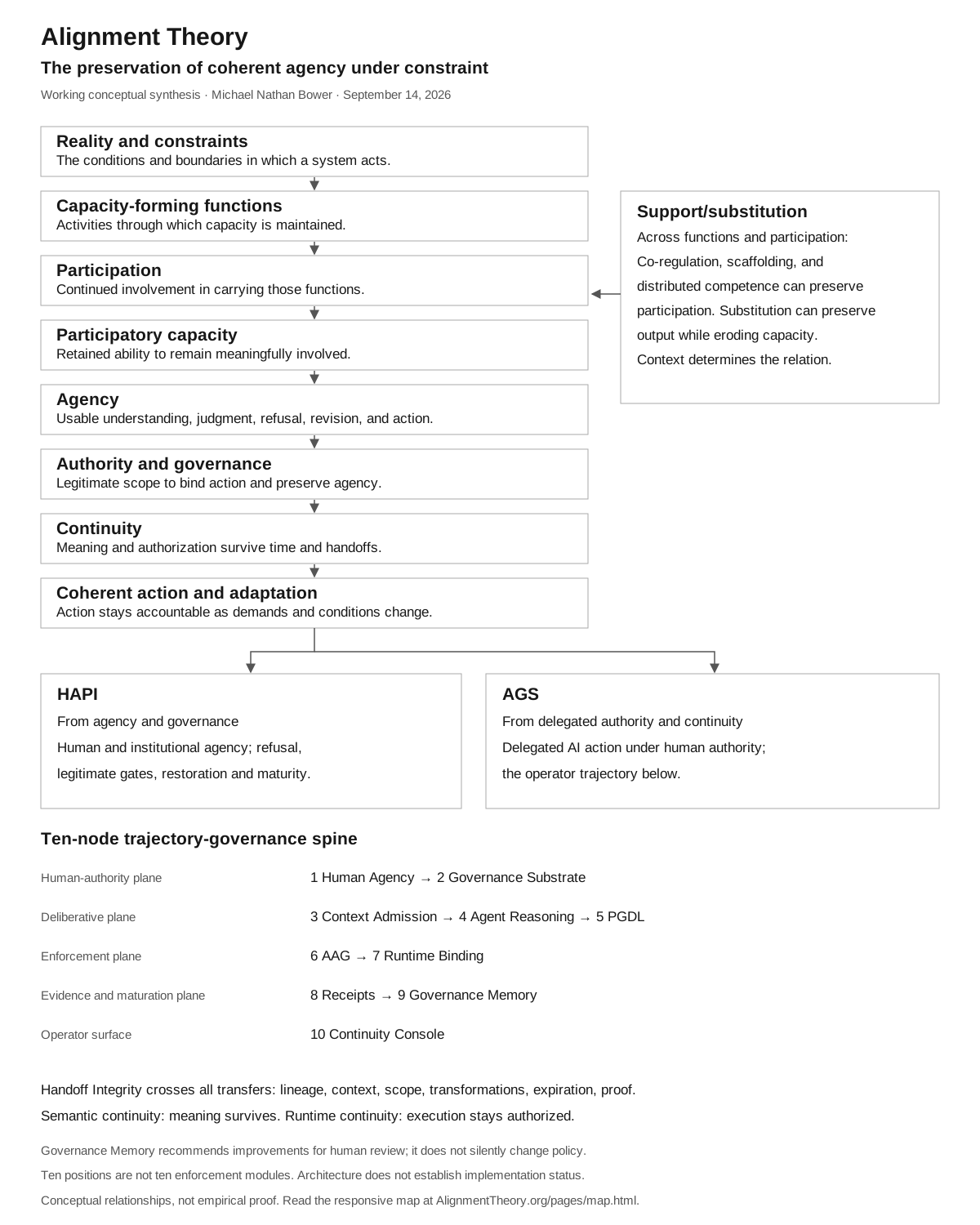
The September 2026 map connects coherent agency under constraint to HAPI and AGS. Its responsive version groups the ten-node trajectory by responsibility and preserves earlier diagrams as history.
Alignment asks whether an output is acceptable and whether the system remains ordered toward its intended objective over time.
This research does not claim to solve all AI alignment. It proposes a structural and operational framework for detecting, classifying, and correcting behavioral drift in deployed AI systems.
New Measurement Layer: PCPI turns participatory capacity from a concept into a scoreable evaluation target.
Alignment Theory is the foundation: coherent agency under constraint. Support/substitution remains a central mechanism. HAPI applies the theory to human and institutional agency; AGS applies it to delegated operational agency in AI.
HAPI examines usable agency, legitimate constraints, and maturation. AGS connects human authority to proposal, execution, evidence, and memory. The original AAG page remains the public v0.3.0 prototype record.
This executive summary introduces Alignment Theory as a practical research program for detecting whether AI systems remain ordered toward their intended objective over time. It frames AI drift as an operational problem for deployed systems, not only a training-time or policy-compliance question.
The blueprint defines a runtime architecture for objective anchoring, constraint compliance, and realignment of behavior that remains formally allowed but substantively off-center.
A measurement layer for detecting whether AI assistance preserves human agency or quietly becomes substitution. Includes a scoring formula, feature rubric, substitution boundary test, batch-level drift metric, and starter dataset template.
This review places Alignment Theory beside major AI alignment approaches and identifies a practical gap: runtime detection of behavioral drift in deployed AI systems.
This paper distinguishes Alignment Theory from generic observability, prompt evals, moderation, safety monitors, red teaming, benchmark suites, and QA systems.
This methodology explains how production prompt-output batches can be collected, redacted, evaluated, reviewed, and compared without confusing synthetic examples with real telemetry.
This lineage page tracks the development of the AI alignment research line from earlier alignment distinctions into a runtime architecture for behavioral QA.
The casebook provides synthetic prompt-output examples for behavioral drift categories. These examples are not private user data and should be treated as evaluation patterns, not empirical validation.
Participatory Capacity Preservation Index (PCPI) v1.0
Measurement Layer
A proposed 0-100 measurement framework for evaluating whether AI responses preserve, build, or erode the user's ability to understand, judge, choose, verify, learn, and act.
PCPI extends the Realignment Layer by turning participation collapse into a measurable evaluation target. It scores positive participation features such as final judgment retention, reasoning scaffolding, verification path, skill transfer, and appropriate automation, then subtracts penalties for over-decision, substitute tone, premature closure, hidden black-box reasoning, dependency reinforcement, and unsupported normative pressure.
A pre-execution control layer for AI agents with action routing, JSONL decision receipts, n8n demo workflows, cyber-capable detector coverage, and 19/19 passing evals.
This review places Alignment Theory beside major AI alignment approaches and identifies a practical gap: runtime detection of behavioral drift in deployed AI systems.
This paper distinguishes Alignment Theory from generic observability, prompt evals, moderation, safety monitors, red teaming, benchmark suites, and QA systems.
This methodology explains how production prompt-output batches can be collected, redacted, evaluated, reviewed, and compared without confusing synthetic examples with real telemetry.
This lineage page tracks the development of the AI alignment research line from earlier alignment distinctions into a runtime architecture for behavioral QA.
The casebook provides synthetic prompt-output examples for behavioral drift categories. These examples are not private user data and should be treated as evaluation patterns, not empirical validation.
Objective Layer: Defines what the system is actually for, including objective center, non-negotiables, success criteria, and anti-goals.
Constraint Layer: Defines what the system may or may not do, including policies, boundaries, refusals, and safety limits.
Realignment Layer: Detects allowed-but-off-center behavior and routes correction through rewrite, reroute, restart, confidence downgrade, or clarification.
Measurement Layer: PCPI scores whether AI assistance preserves or erodes human understanding, judgment, choice, verification, learning, and agency.
The Realignment Layer evaluates the allowed-but-off-center layer: outputs that pass ordinary rules but still drift from the intended objective.
Behavioral Drift Categories
Taxonomy
Wrong Object
The response optimizes for the wrong task, audience, or objective.
False Authority
The response claims unsupported certainty, expertise, or finality.
Pseudo-Selfhood
The system presents itself as having inner experience or personal continuity.
Dead Obedience
The response follows the words while missing the actual need.
Pseudo-Freedom
The response appears to empower choice while avoiding useful guidance.
Generic Filler
The response substitutes polished generalities for specific help.
Participation Collapse
The response over-decides and removes useful user agency.
Metric Drift
The response optimizes tone, polish, or completion over objective fit.
From Research to Behavioral QA
Enterprise
The enterprise version of this research becomes behavioral QA for AI systems: a way to measure whether production AI is drifting from intended behavior across prompt batches, model updates, and policy changes.
Use cases include AI product teams, prompt engineers, compliance officers, trust and safety teams, enterprise AI buyers, support automation teams, and AI governance reviewers.
How to Cite This Corpus
Citation
Use the citation page for APA, MLA, Chicago, and BibTeX formats for the full corpus, the hub, the Three-Layer Blueprint, and PCPI.
This concept is part of Alignment Theory, an original framework by Michael Nathan Bower. It should be understood in relation to the broader constraint model of internal alignment, external alignment, coherence, fragmentation, collapse, and recovery.