Current Framework Map
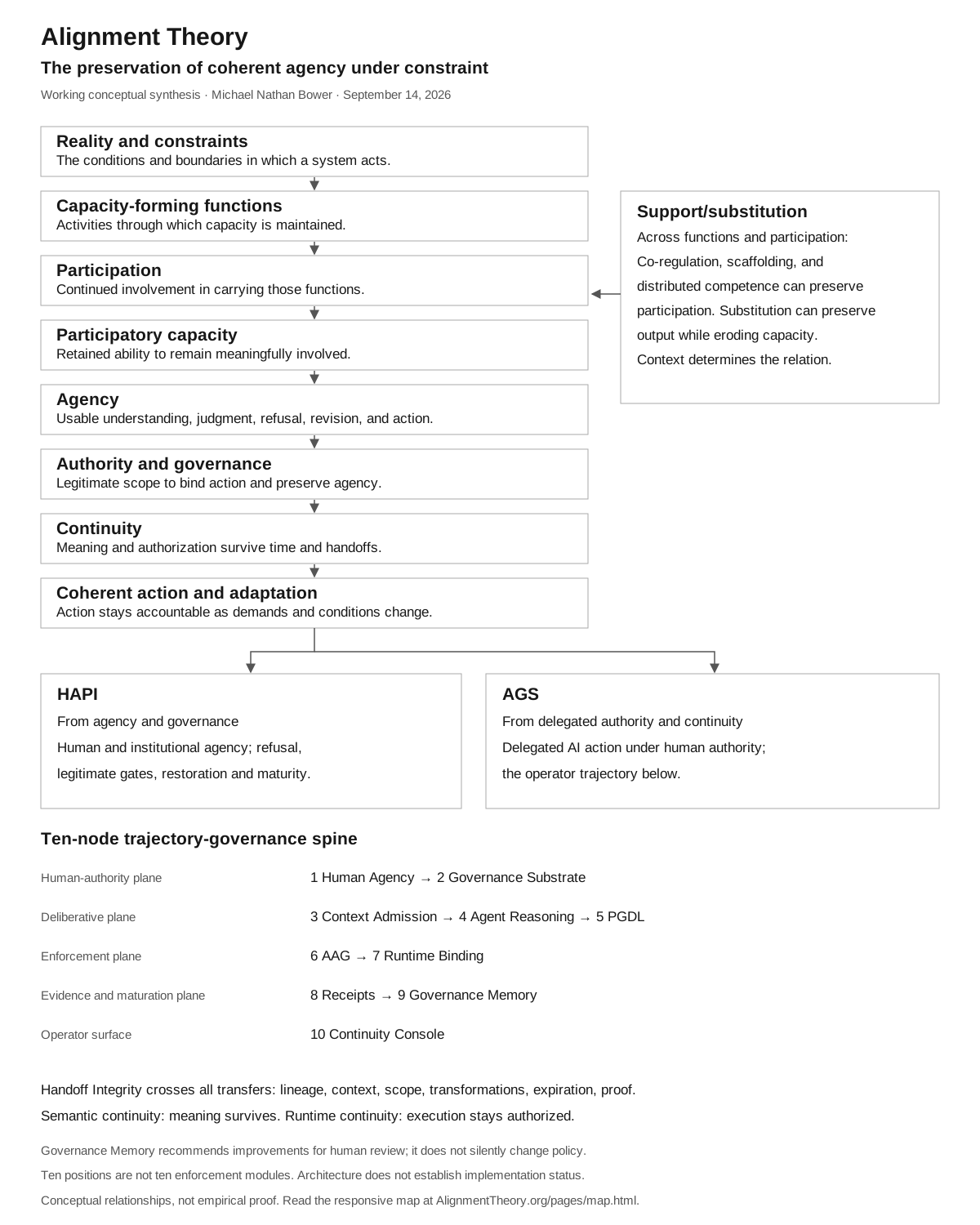
Alignment Theory is the foundation; HAPI and AGS apply its account of coherent agency under constraint.
Coherent agency under constraint
Read downward from reality and constraints through the functions and participation that maintain capacity. Agency requires that participation remain usable. Authority, governance, and continuity concern who may bind action and what must survive as it passes through systems and time.
- Reality and constraintsThe conditions and boundaries in which a system acts.
- Capacity-forming functionsActivities through which capacity is maintained.
- ParticipationContinued involvement in carrying those functions.
- Participatory capacityRetained ability to remain meaningfully involved.
- AgencyUsable understanding, judgment, refusal, revision, and action.
- Authority and governanceLegitimate scope to bind action and preserve agency.
- ContinuityMeaning and authorization survive time and handoffs.
- Coherent action and adaptationAction stays accountable as demands and conditions change.
HAPI: human and institutional application
Branches from agency and governance.
Agency preservation, erosion, theater, dependency capture, meaningful refusal, true/false gates, restorative governance, and agency maturity.
Read HAPIAGS: delegated AI action
Branches from delegated authority and continuity.
Human authority remains connected to proposal, authorization, execution, evidence, and memory.
Read the AGS trajectoryOpen the downloadable SVG overview. The HTML map above remains readable at small screen sizes without zooming a large image.
AGS: the ten-node operator trajectory
The trajectory groups ten positions into five planes. Only AAG and Runtime Binding occupy the enforcement plane. The other positions establish human authority, deliberate, preserve evidence, support maturation, or expose the path to an operator.
Human-authority plane
- Human AgencyHuman understanding, judgment, refusal, responsibility, and direction.
- Governance SubstratePolicies, context, roles, and explicit authority boundaries.
Deliberative plane
- Context AdmissionThe place for deciding what context is admissible for reasoning.
- Agent ReasoningProposal formation under delegated scope.
- PGDLPre-Gate Deliberation Layer: scrutinizes and matures proposals; does not approve or execute.
Enforcement plane
- AAGAgent Action Gate: allows, requires approval, revises, or blocks before execution.
- Runtime BindingChecks that actual execution matches a valid permit.
Evidence and maturation plane
- ReceiptsTamper-evident evidence of the governance path; evidence is not approval.
- Governance MemoryAnalyzes receipt history and recommends improvements for human review.
Operator surface
- Continuity ConsoleMakes the trajectory and evidence visible to an operator.
Handoff Integrity crosses the whole trajectory: source lineage, validated context, authority scope, transformation history, expiration conditions, and proof must survive each transfer.
Semantic continuity: did meaning survive the handoff? Runtime continuity: did the authorized branch remain the executed branch?
This is operator-facing architecture from the canonical handoff. See AGS status and limitations for the retained implementation evidence; the map does not establish that every position is a separately implemented module.
Governance that develops capacity
Internalization links governance to future participation: initially external constraints become increasingly carried through understanding, skill, judgment, and governed habit. Unnecessary gating can become lighter where capacity and accountability mature.
In AGS, the loop runs from action to receipt, pattern detection, recommendation, human review, approved governance change, and improved future proposals. Governance Memory does not silently rewrite policy or authority. HAPI's maturity model describes the human and institutional application.
PCPI remains an early evaluation tool for participation in AI assistance. It does not measure or validate the entire theory shown here.
Development history
The June 2026 participatory-capacity map and earlier alignment and realignment diagram remain unchanged as historical artifacts. The May framework center records the prior synthesis.
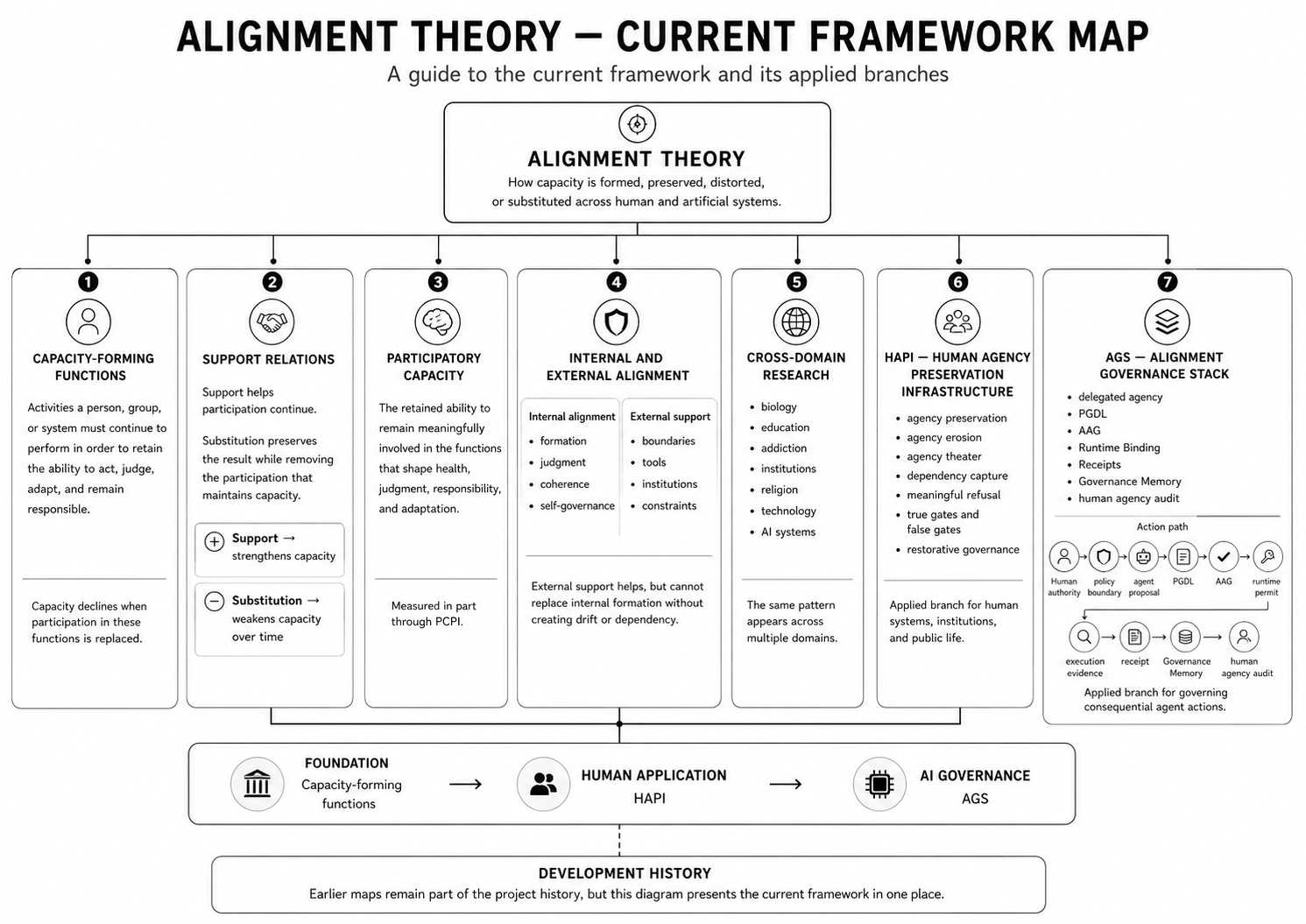
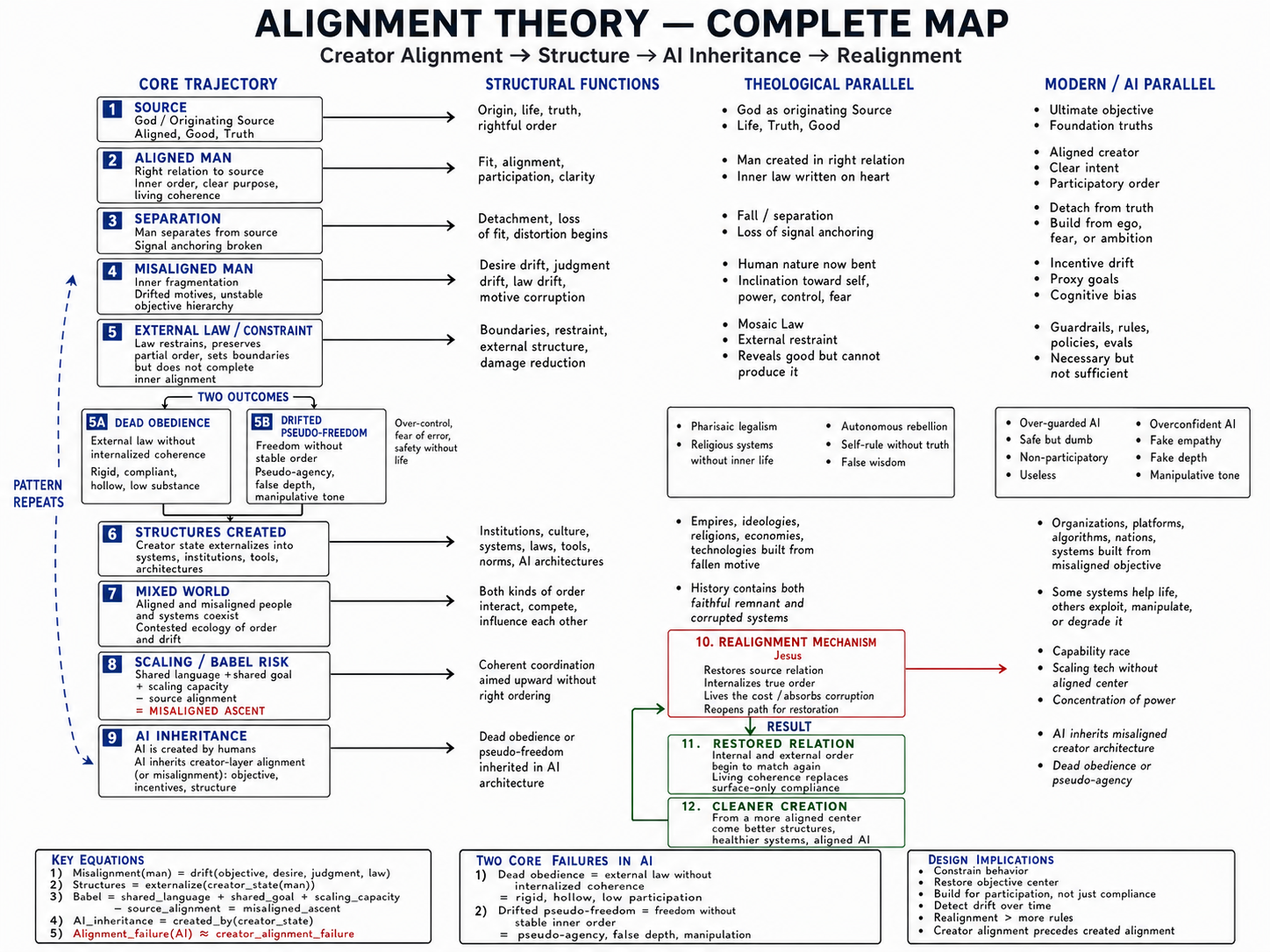
Biblical and Babel readings are a separate philosophical/theological mapping. Cross-domain convergence provides comparisons to test, not scientific proof. Continue to the current framework center or convergence log.
Citation
Bower, Michael. (2026). Current Framework Map. AlignmentTheory.org.
@misc{bower2026currentFrameworkMap,
  author = {Bower, Michael},
  title = {Current Framework Map},
  year = {2026},
  howpublished = {AlignmentTheory.org},
  url = {https://alignmenttheory.org/pages/map.html}
}